Please participate in my action research study by commenting on another Blog of mine. You need not log into Blogger to post a comment so you can be completely anonymous.
http://tjactionresearch.blogspot.com/
Thanks,
Mr. Joe.
Tuesday, May 5, 2009

Holocaust Webquest
Follow this link and answer the questions.
http://www.cyberlearning-world.com/lessons/ushistory/webquest1.
http://www.cyberlearning-world.com/lessons/ushistory/webquest1.
Tuesday, April 14, 2009
Russian Revolution Webquest
Use the resource links below to answer the following 20 questions. You may work with a partner to split up the questions You may copy them into a word documane or write on the handout:
Russian Revolution
Use the Internet information linked below to answer these questions :
Use these links to help you answer the questions below that are specifically related to the Russian Revolution.
Russian Revolution - Historical background on the Russian Revolution.
Discussions of Serfs in the Romanov empire in the 1800's
BBC Modern World History - Question-based article links (good)
Marxism - A description of Marxism as proposed by Karl Marx.
Downfall of Czar Nicholas II - A brief description of the last days of Czar Nicholas II.
Modern World History: Stalin - A description of Stalin and his role in the Russian Revolution.
Was Stalin the world's bloodiest tyrant? Interesting argument about the bloodiest tyrant of the 20th century
Leon Trotsky - A description of Trotsky and his role in the Russian Revolution.
1. In the early 1800's, what percentage of the Russian population were serfs?
2. Who were the Decembrists?
3. Who were the Social Revolutionaries?
4. Who were the Social Democrats?
5. Who was the 'man of steel'?
6. List three reasons why there was a revolution in Russia in February 1917.
7. How did the first world war affect Russia?
8. Why were the Bolsheviks able to seize power in October 1917?
9. What factors led to the outbreak of civil war in Russia in 1918.
10. List the successive stages of history as described by Karl Marx.
11. According to Marxism, how does the ruling class forcibly maintain control over the other classes?
12. Describe Revisionism.
13. What was Nicholas II's reaction when the Duma proposed a plan to reform the policy of land distribution?
14. How did Nicholas II justify his power to arbitrarily and unconstitutionally change laws?
15. How did Stalin become the leader of Russia after the death of Lenin?16. In what ways did Stalin try to change agriculture and industry in the Soviet Union?
17. How did Stalin try to eliminate opposition in the 1930's?
18. After the death of Lenin, what two individuals vied for leadership of the Soviet Union?
19. What were the national goals for the Soviet Union that each of these individuals proposed?
20. What eventually happened to each of these individuals?
Russian Revolution
Use the Internet information linked below to answer these questions :
Use these links to help you answer the questions below that are specifically related to the Russian Revolution.
Russian Revolution - Historical background on the Russian Revolution.
Discussions of Serfs in the Romanov empire in the 1800's
BBC Modern World History - Question-based article links (good)
Marxism - A description of Marxism as proposed by Karl Marx.
Downfall of Czar Nicholas II - A brief description of the last days of Czar Nicholas II.
Modern World History: Stalin - A description of Stalin and his role in the Russian Revolution.
Was Stalin the world's bloodiest tyrant? Interesting argument about the bloodiest tyrant of the 20th century
Leon Trotsky - A description of Trotsky and his role in the Russian Revolution.
1. In the early 1800's, what percentage of the Russian population were serfs?
2. Who were the Decembrists?
3. Who were the Social Revolutionaries?
4. Who were the Social Democrats?
5. Who was the 'man of steel'?
6. List three reasons why there was a revolution in Russia in February 1917.
7. How did the first world war affect Russia?
8. Why were the Bolsheviks able to seize power in October 1917?
9. What factors led to the outbreak of civil war in Russia in 1918.
10. List the successive stages of history as described by Karl Marx.
11. According to Marxism, how does the ruling class forcibly maintain control over the other classes?
12. Describe Revisionism.
13. What was Nicholas II's reaction when the Duma proposed a plan to reform the policy of land distribution?
14. How did Nicholas II justify his power to arbitrarily and unconstitutionally change laws?
15. How did Stalin become the leader of Russia after the death of Lenin?16. In what ways did Stalin try to change agriculture and industry in the Soviet Union?
17. How did Stalin try to eliminate opposition in the 1930's?
18. After the death of Lenin, what two individuals vied for leadership of the Soviet Union?
19. What were the national goals for the Soviet Union that each of these individuals proposed?
20. What eventually happened to each of these individuals?
Friday, March 20, 2009
Europe in 1914: How did Alliances effect the beginning of World War I?
At the start of the Great War in 1914, Germany was a relatively young power, only coming into existence following a series of wars in 1871. Germany's Chancellor, Otto von Bismarck, had shepherd the country into the 20th century with the adage that Germany must always be in a majority of three in any dispute among the five great European powers. His aim was to maintain peaceful ties with Russian. When Kaiser Wilhelm II came to power, he quickly retired Bismarck, and upset the Chancellor's delicate balance of power by refusing to renew Germany's friendship with Russia. Germany soon found itself in a minority of two. Its only European ally was the weakest of the European powers, Austria-Hungary.
The tripwire that set off the century's first global conflict was Austria's declaration of war against Serbia on July 28, 1914, a month after Archduke Franz Ferdinand (the heir to the Austro-Hungarian throne) was assassinated in Sarajevo by a Serbian fanatic. A war between Austria and Serbia meant a war between Austria and Russia -- Serbia's traditional ally. That meant war between Russia and Germany. And that meant war between Germany and France. And that meant war between Germany and Great Britain. In a flash, the whole continent was at war.
The tripwire that set off the century's first global conflict was Austria's declaration of war against Serbia on July 28, 1914, a month after Archduke Franz Ferdinand (the heir to the Austro-Hungarian throne) was assassinated in Sarajevo by a Serbian fanatic. A war between Austria and Serbia meant a war between Austria and Russia -- Serbia's traditional ally. That meant war between Russia and Germany. And that meant war between Germany and France. And that meant war between Germany and Great Britain. In a flash, the whole continent was at war.
The Outbreak of War: What was the Schlieffen Plan, did it work and how did it effect the War?
At the outbreak of war, the German High Command activated the Schlieffen Plan, which called for a major offensive to capture Paris in precisely 42 days. The German army would avoid France's line fortifications by sweeping west through neutral Belgium and then turning in a huge arc south into France. The French army would be destroyed defending Paris. The German generals were so confident of success that Kaiser Wilhelm II proclaimed that he would have "Paris for lunch, St. Petersburg for dinner." If the plan worked, France would be forced to surrender and Germany could shift its forces to the eastern front and defeat the Russians before they were fully prepared to fight. According to the German generals the war would be over by Christmas, only five months after it began. As the German army advanced through Belgium, the French believed that this was a diversion, and sent most of the French army northeast to attack Germany through the lost provinces of Alsace and Lorraine. The French would loose 27,000 men in a single day, proving that the machine gun and the long-range rifle were devastating defensive weapons against traditional warfare tactics.
But the Schlieffen Plan soon began to unravel. The German army, having advanced rapidly through Belgium and deeply into France, found themselves physically exhausted and far ahead of their supply lines. As the German right flank drove towards Paris, it separated from the rest of the invading force. Recognizing their vulnerability, the Germans pulled up twenty-five miles short of Paris. Now it was France's chance to attack. French General Joffre ordered a stand along the Marne. Meanwhile, on the Eastern Front, a Russian army of some 350,000 men engaged Germany at the Battle of Tannenberg. For Germany it was one of the greatest victories of the war: one third of the Russian troops were either killed or captured; the rest ran for their lives in a disorganized retreat. But even though the victor, the brief penetration into Prussia by the Russians hurt Germany in the end by taking pressure off the beleaguered French Army, as two German Army corps and a cavalry division destined for the final push to take Paris were diverted to the Eastern Front. In early September, the first Battle of the Marne took place, with over two million men participating. The German army was stopped and Paris was saved. Immediately following the first Battle of the Marne, both sides tried to out-flank one another in an effort to swing around the other's defensives. The resulting actions, called by some the "race to the sea," ended with a line of trenches that extended from Switzerland to the English Channel. By mid-September, stalemate had begun and trench warfare had set in. No one suspected that the trench lines that stretched across Western Europe by the end of December 1914 would not change much over the next four years.
But the Schlieffen Plan soon began to unravel. The German army, having advanced rapidly through Belgium and deeply into France, found themselves physically exhausted and far ahead of their supply lines. As the German right flank drove towards Paris, it separated from the rest of the invading force. Recognizing their vulnerability, the Germans pulled up twenty-five miles short of Paris. Now it was France's chance to attack. French General Joffre ordered a stand along the Marne. Meanwhile, on the Eastern Front, a Russian army of some 350,000 men engaged Germany at the Battle of Tannenberg. For Germany it was one of the greatest victories of the war: one third of the Russian troops were either killed or captured; the rest ran for their lives in a disorganized retreat. But even though the victor, the brief penetration into Prussia by the Russians hurt Germany in the end by taking pressure off the beleaguered French Army, as two German Army corps and a cavalry division destined for the final push to take Paris were diverted to the Eastern Front. In early September, the first Battle of the Marne took place, with over two million men participating. The German army was stopped and Paris was saved. Immediately following the first Battle of the Marne, both sides tried to out-flank one another in an effort to swing around the other's defensives. The resulting actions, called by some the "race to the sea," ended with a line of trenches that extended from Switzerland to the English Channel. By mid-September, stalemate had begun and trench warfare had set in. No one suspected that the trench lines that stretched across Western Europe by the end of December 1914 would not change much over the next four years.
Gallipoli: What did the Allies wish to accomplish in Gallipoli? Were they successful? Why or Why not?
On April 24th, 1915, an amphibious force of British, French, Australian, and New Zealand troops began landing on the Turkish peninsula of Gallipoli. Their aim, to knock Germany's ally, Turkey, out of the war. Only a small Turkish force awaited them on the cliffs overlooking the shore. However, the Gallipoli landing was a disaster caused by inadequate intelligence, insufficient attention to the terrain, an underestimation of the enemy's strength and resilience in defense of their native soil. Nine months after landing, the allies withdrew after incurring over 250,000 casualties, including over 46,000 dead.
The Battle of Verdun: Were the German’s successful at Verdun, France? What did Verdun symbolize for the French?
German General Erich von Falkenhayn developed a battle plan for attacking Verdun, France, a city protected by a ring of underground forts. Begun in mid-February 1916, and ending in December, the battle of Verdun symbolized for the French the strength and fortitude of their armed forces and the solidarity of the entire nation. After a few short weeks, the battle took on a life of its own, with small groups of men on both sides fighting local battles in constant struggle for their lives, and protection of the territory they occupied. Verdun is still considered by many military historians as the 'greatest' and most demanding battle in history. In the end, the front lines were nearly the same as when the battles started while over 300,000 French and Germans were killed and over 750,000 were wounded.
The Battle of the Somme: Why is this battle significant in British military history? What were the results?
One hundred and twenty-five miles northwest of Verdun, the British and French armies joined at the Somme River. A Franco-British offensive was planned here for 1916 to relieve pressure on the French at Verdun. British General Douglas Haig ordered a massive bombardment of the German lines that would last a week and could be heard across the Channel in England. But the German troops were deeply dug in and the bombardment did not reach them. Once the shelling was over, of the 100,000 British troops who attacked the German lines July 1, 1916, 20,000 were killed and over 40,000 were wounded. It was the single worst day in deaths and casualties in British military history. Eventually this battle, which did not change the front line trenches much at all, involved over 2 million men along a 30 mile front. British and French losses numbered nearly three-quarters of a million men.
The Battle of Ypres, Belgium: How did the weather effect the battle of Ypres? Was it a success for the British?
British General Douglas Haig often believed his army was on the verge of a breakthrough. His optimism resulted in a plan in 1917 to attack the German lines just outside of Ypres, Belgium. This would be the third battle at Ypres, the other two having taken place in 1914, and 1915. Once Haig's army broke through, he envisioned it sweeping across the low plains and swinging north to the sea. On the morning of June 7, 1917, the Allies set off a series of nineteen giant mines dug over eighteen months under the German lines south-east of Ypres. Together with a sophisticated counter-battery operation, this stroke completely disrupted and disorganized German defensive positions. The initial advance ended successfully, but then weeks passed before the British troops were ordered to continue by which time the wettest fall in years had set in. In this three-month battle, men, animals and equipment were swallowed up in mud that was often like quicksand, Haig's ambitious plan became yet another failure.
The Western Front in 1918: Did the trench lines change much prior to the Armistice?
Over a four-month period in 1918, the German army launched five major assaults at different parts of the allied line. The new campaign was based on new tactics: squads of elite storm-troopers, armed with automatic rifles, light machine guns and flame-throwers, were supported with a creeping barrage of artillery fire. Initially the plan worked. The British Fifth Army collapsed. The allies gave ground. But for every allied trench captured, there was always another for the Germans to take. Within a week the advance had ground to a halt. Soon the elite German storm troopers were a spent force. The allies, having stemmed the German advance, now reversed it. The whole front was ablaze. The climatic battles of September 1918 saw the rupture of the Hindenburg Line, and on the 11th hour of the 11th day of the 11th month of 1918, the armistice went into effect.
Google Docs collabotation
Per 5 Document Link
per 5 slideshow link
Per 6 Battles Doc
Per 6 Battles Slideshow
World war one links.
Interesting media room http://www.worldwar1.com/
Really good overall: http://www.firstworldwar.com/
per 5 slideshow link
Per 6 Battles Doc
Per 6 Battles Slideshow
World war one links.
Interesting media room http://www.worldwar1.com/
Really good overall: http://www.firstworldwar.com/
Thursday, March 19, 2009
Battles of WWI
We are investigating various key battles and answering these questions:
Europe in 1914: How did Alliances effect the beginning of World War I?
The Outbreak of War: What was the Schlieffen Plan, did it work and how did it effect the War?
Gallipoli: What did the Allies wish to accomplish in Gallipoli? Were they successful? Why or Why not?
The Battle of Verdun: Were the German’s successful at Verdun, France? What did Verdun symbolize for the French?
The Battle of the Somme: Why is this battle significant in British military history? What were the results?
The Battle of Ypres, Belgium: How did the weather effect the battle of Ypres? Was it a success for the British?
The Western Front in 1918: Did the trench lines change much prior to the Armistice?
A good site to start link
We are going to answer these questions using a common document on Google docs.
Here is the link. Or try here
Europe in 1914: How did Alliances effect the beginning of World War I?
The Outbreak of War: What was the Schlieffen Plan, did it work and how did it effect the War?
Gallipoli: What did the Allies wish to accomplish in Gallipoli? Were they successful? Why or Why not?
The Battle of Verdun: Were the German’s successful at Verdun, France? What did Verdun symbolize for the French?
The Battle of the Somme: Why is this battle significant in British military history? What were the results?
The Battle of Ypres, Belgium: How did the weather effect the battle of Ypres? Was it a success for the British?
The Western Front in 1918: Did the trench lines change much prior to the Armistice?
A good site to start link
We are going to answer these questions using a common document on Google docs.
Here is the link. Or try here
Wednesday, March 4, 2009
Gandhi Blog assignment
Create a post on your blog which includes the following:
- An image of Mohandis Gandhi
- A definition of the term Imperialism
- Definitions of the terms civil disobedience and passive resistance
- A summary of either of these events: the Amritsar Massacre or the Salt March
Wednesday, January 14, 2009
Industrial revolution assignments
New assingnment: Capitalism v. Communison categorization
These were all posted Jan. 10th, 2008 on this blog here are the links and instructions:
Capitalism v. Communism Categorization Project
1. Create your publisher file
2. Summary textbox at the bottom of your project
3. Quotes for Capitalism v. Communism categorization
4. Images for Capitalism v. Communism categorization
Outstanding assignments:
Dec. 15th: Explore and document Victorian inventions
Dec. 11th: Industrial revolution (video clips)
These were all posted Jan. 10th, 2008 on this blog here are the links and instructions:
Capitalism v. Communism Categorization Project
1. Create your publisher file
2. Summary textbox at the bottom of your project
3. Quotes for Capitalism v. Communism categorization
4. Images for Capitalism v. Communism categorization
Outstanding assignments:
Dec. 15th: Explore and document Victorian inventions
Dec. 11th: Industrial revolution (video clips)
Monday, December 15, 2008
Explore and document Victorian inventions
View the animations in the Technology section of this link.
Who wants to be a Cotton Millionaire? - tesdt your skills as a businessman
Muck and Brass - make important decisions as you run Cottonopolis
Stephenson's Rocket Animation - Inside the trailblazing steam engine
The Blast Furnace Animation - Inside the device that shaped the industrial revolution
The Spinning Mill Animation - Inside the machinery that revolutionised textiles
Winding Gear Animation - Inside this mechanism of the industrial age
The Beam Engine Animation - Inside the Victorian engine
Paddle Steamship Animation - Inside the engine of a paddle steamer
Choose one to describe on your Blog and discuss how it heped improve life in the Industrial Revolution.
Who wants to be a Cotton Millionaire? - tesdt your skills as a businessman
Muck and Brass - make important decisions as you run Cottonopolis
Stephenson's Rocket Animation - Inside the trailblazing steam engine
The Blast Furnace Animation - Inside the device that shaped the industrial revolution
The Spinning Mill Animation - Inside the machinery that revolutionised textiles
Winding Gear Animation - Inside this mechanism of the industrial age
The Beam Engine Animation - Inside the Victorian engine
Paddle Steamship Animation - Inside the engine of a paddle steamer
Choose one to describe on your Blog and discuss how it heped improve life in the Industrial Revolution.
Thursday, December 11, 2008
Industrial revolution
Watch the two video clips below and answer this question on your Blog or in a Word document.
In England, around 1750, many factors seemed to come together to create the Industrial Revolution. What were some of these factors? (Include geographic, social and technology reasons)
In England, around 1750, many factors seemed to come together to create the Industrial Revolution. What were some of these factors? (Include geographic, social and technology reasons)
Monday, December 8, 2008
Italian unification assignment
Do some Internet research and get the following:
- Before and after maps of Italian Unification
- Info on Camillo Cavour, the two Giuseppis: Garibaldi and Mazzini and Victor Emmanuel
- Timeline of key events
Combine the three elements above to produce a brief overview of the Italian unification. You may submit on your blog or use a software application of your choosing (Word, Publisher, Inspiration or PowerPoint)
Due by the end of this week.
Try this link for before and after maps

Friday, December 5, 2008
DBQ 15 Nationalism in the 18th Century

Upload this image to your blog. (copy and save from here or it is on the Share drive josephson\Global ii\nationalism).
Post your introduction, topic sentences for each body paragraph and conclusion to your Blog.
Friday, November 21, 2008
Nationalism Hero Profile
The French Revolution inspired a great rise in feelings of Nationalism not only in France, but throughout Europe and their territories in the Americas. Your assignment is to create a single page profile of one of the leaders of Nationalistic movements.
For full credit, include the following:
For full credit, include the following:
- Person's name and when he lived
- Which nation(s) he or she were active in promoting Nationalism
- The definition of Nationalism
- A specific challenge they faced
- An interesting or curious aspect of this person
- A summary of the impact of that person on the Nation
You may use Word, PowerPoint or Publisher (recommended) to create your project. Choose from the list below or ask me for permission if you would like to cover someone else.
Italy: Camillo Cavour, Giuseppi Garibaldi, Giuseppi Mazzini
Germany: Otto Von Bismarck
Haiti: Toussaint L'Overture
Latin America: Simon Bolivar, Jose de San Martin
Mexico: Miguel Hidalgo
Chile: Bernard O'Higgins
Turkey: Kemal Attaturk
Due after Thanksgiving break (December 1st)
Extra Credit: post it to your Blog, make a poster and/or present to the class
Tuesday, September 9, 2008
Machiavelli "Power Quote" assignment
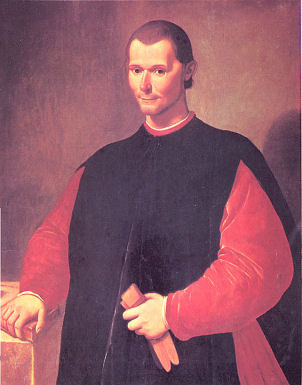
- Follow this link and read a brief overview of Niccolo Machiavelli
- Go to this link to read quotes by Machiavelli
- Select a quote that you feel helps a ruler acquire or maintain power.
- Copy the quote into a post on your Blog and explain why it would help a ruler increase or keep their power.
Subscribe to:
Posts (Atom)